

Developer Marketing Engineer
Species yet to be discovered.

Some time ago, Clay introduced a very specific term: GTM engineer.
At first glance, it’s easy to dismiss it as just another fancy name for sales. After all, we’ve had sales, sales engineering, demand generation, growth - pick your flavor. Titles change. Org charts get reshuffled.
For years, go-to-market motions relied on scale rather than precision. Broad outreach. Generic messaging. Large volumes, vague targeting. Every now and then something would land. Most of the time it wouldn’t and eventually, spam filters caught up.
At some point Clay flipped the model.
Instead of optimizing for volume, they built tooling around context engineering, deeply understanding who you’re reaching, why now, and what signals actually matter. That context then powers highly targeted outreach that feels less like a campaign and more like a well-timed conversation.
If you get your ICP right, which Clay helps with too, the impact on activation and conversion can be significant. And that’s before you even look at the rest of the use cases the platform enables.
Why Clay matters here
Recently I came across one of the recent post from Ian Vanagas about generic job titles and more importantly generic job descriptions.
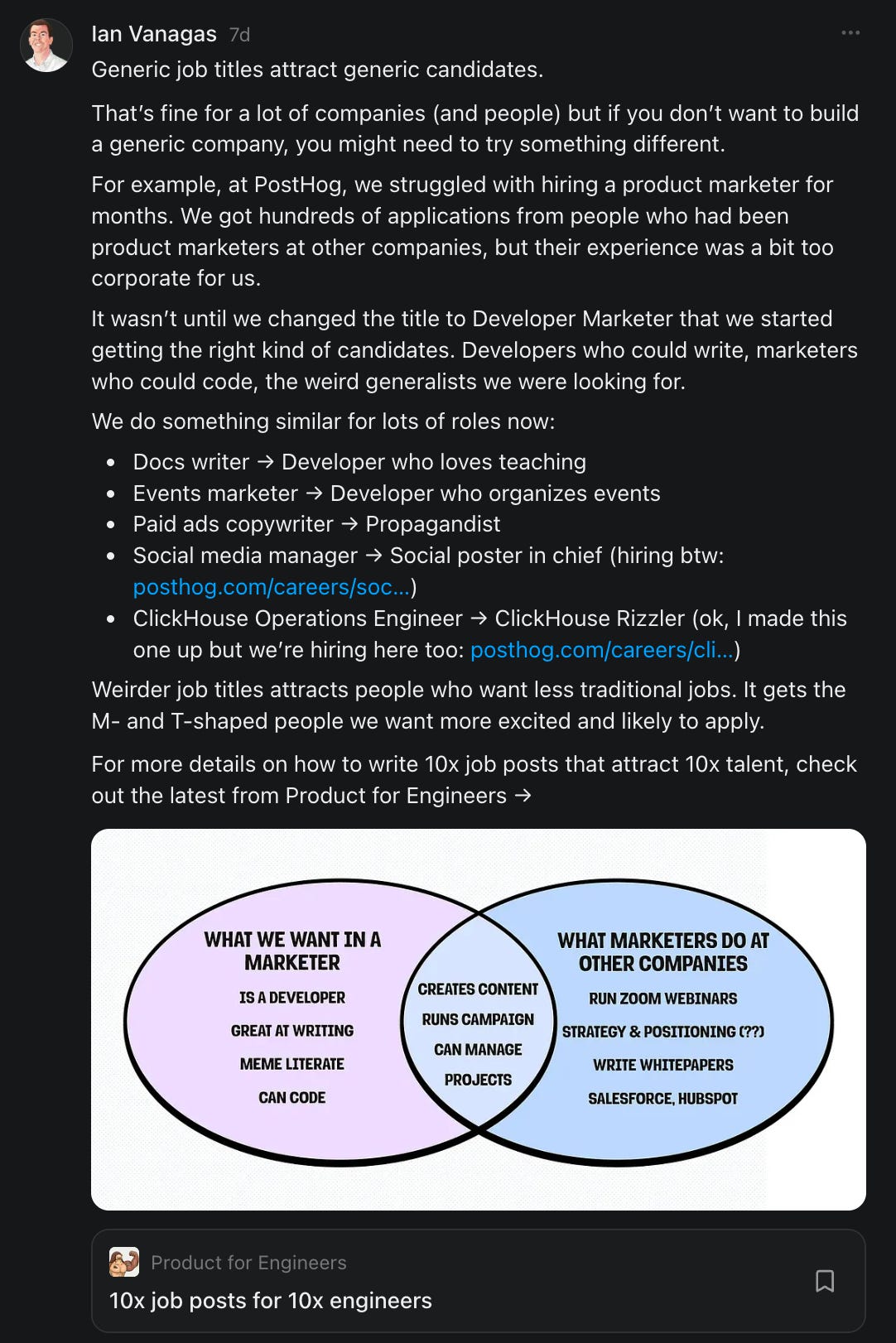
You don’t even need to read the full piece to get the point.
PostHog needed to tweak the positioning and messaging of their product marketer listing, likely more than once (probably) as a result of interviewing candidates and realizing they weren’t hitting the ICP for the role.
What initially looked like a perfectly reasonable job tlisting turned out to be too broad. Shifting to a newer, more specific one made the role legible to the exact kind of people PostHog was looking for.
Not more people. The right people.
If you’ve spent any time around DevRel, developer marketing, or hybrid roles, this probably doesn’t sound surprising. These disciplines have always lived slightly outside traditional org charts and that ambiguity is often the point.
So how does this connect back to Clay?
The gap between developer marketer and technical product marketer
There’s a growing number of developer and technical product marketing roles out there, especially in devtools. You won’t find them neatly labeled on LinkedIn Jobs, but they exist, and more teams are quietly hiring for them.
The obvious question is: who actually applies for these roles?
Usually, it’s some mix of:
Developers who pivoted into marketing: they understand the internals and now want to learn how to market them
Marketers who suddenly started LLM-ing their way through everything: dangerous, but occasionally effective
Developer relations folks: they’ve touched product, engineering, sales, and marketing already so why not add one more hat?
Product marketing managers from technical companies: The kind who’ve gone from drag-and-drop UIs to database internals and had to recalibrate what “technical” really means
Product people who’ve done a bit of both: enough engineering to build empathy, enough marketing to shape narratives
Every company will naturally optimize for a different mix, depending on its product, stage, and constraints.
What’s less clear and increasingly uncomfortable is:
What exactly is developer marketing and technical product marketing today?
The Developer Marketing Engineer
In the LLM era, the clean line between developer and technical product marketer is slowly disappearing. The name Developer Marketing Engineer tells you that this is a generalist role by design.
Imagine a person who:
Codes
Does product positioning and messaging work (and rework)
Handles competitive intelligence
Is able to run GTM campaigns and product launches end to end (strategy, planning, hands-on execution, success metrics setup and tracking)
Does technical & non technical content engineering (newsletters, blogs, socials, quickstarts, guides, live demos, product go-through videos with voiceover, etc.)
Runs growth experiments
Does GTM engineering with tools like Clay
Ghostwrites
Handles all aspects of co-marketing with other players
And on top of that, have domain experience in the field that a specific company is interested in.

But just like with GTM Engineers, the role didn’t appear because someone invented a title. The title appeared because the work was already being done, and usually under a different name.
These people exist. They’re just rare. And they know it.
Before you go
Would you rather bet on a developer who learned marketing or a marketer who’s learning to become technical with the help of LLMs?